
Cheese Stories
Useful and fun cheese stories
- Ricotta
- 2025-02-10
Ricotta
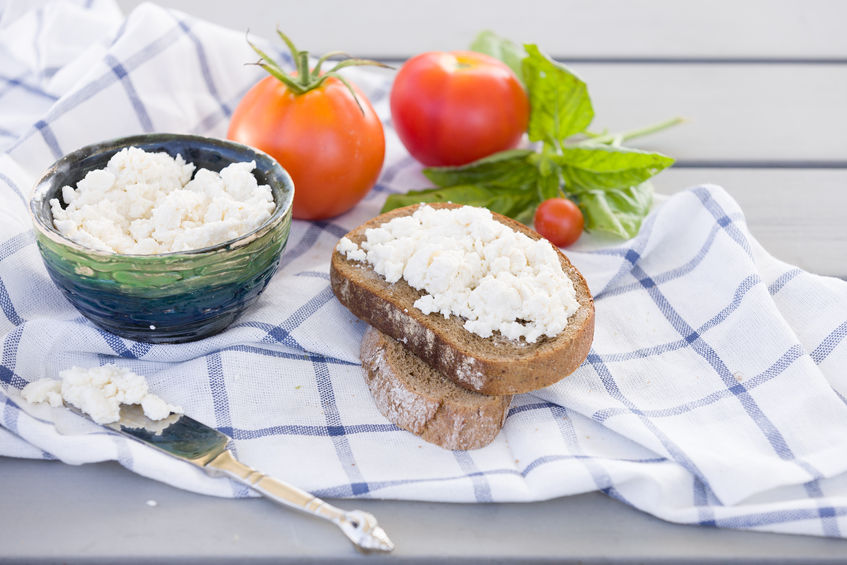
Made from the yellow whey that is produced during cheese-making, it is closer to a dairy product than a traditional cheese.
It has a pure white color, a soft texture, and a sweet taste, with low fat content, so it is not greasy.
Place of Origin: Italy
Cheese Classification: Fresh Cheese
Characteristics:
It is mainly served with salads, often paired with herbs, and can also be eaten with sugar-cured fruits as a dessert.
Ricotta is a key ingredient in lasagna and pairs well with wine.
Tip!
Difference Between Ricotta and Cottage Cheese
Ricotta and cottage cheese are so similar that they are often hard to distinguish.
Both are sweet, fresh cheeses that are almost unaged and can be eaten immediately after being made.
Ricotta has a grainy texture, while cottage cheese forms larger and smaller lumps, but both are soft, mild, and typically white.
Both are usually sold in round plastic containers and can often be substituted for each other in recipes.
However, there are clear differences in the ingredients and production methods.
Ricotta is made by boiling the leftover whey from cheese production, while cottage cheese is made by curdling casein, the protein in milk.
The proteins remaining in the whey used to make ricotta are mostly albumin or globulin.
Since ricotta is not made by coagulating the main milk protein, casein, it is more accurately classified as a dairy product rather than a cheese in the strict sense.
Additionally, ricotta has a lower fat content, making it feel lighter in the mouth, and because it doesn't contain casein, it is easier for people who are naturally unable to digest it to consume.
On the other hand, cottage cheese is made by curdling casein, the protein in milk.
While whey is drained from the curd, it is not pressed and squeezed as hard as other cheeses, so some whey remains, making it moist and soft in texture.
This is why it can easily be confused with ricotta.
[Source: Naver Knowledge Encyclopedia]



Dairygen Co., Ltd.
14, Bansan 1-ro, Munmak-eup, Wonju-si, Gangwon Special Self-Governing Province
Business Registration Number: 224-81-26380 TEL: +82-33-732-8624 Email: cs@dairyzen.co.kr Personal Information Manager: Choi Su-ok
Copyright © DAIRYZEN All rights reserved.